<?xml version="1.0" encoding="UTF-8"?>
<feed xmlns="http://www.w3.org/2005/Atom">
  <id>https://frantic.im/</id>
  <title>frantic.im</title>
  <link rel="self" href="https://frantic.im/feed.xml" />
  <icon>https://frantic.im/favicon.png</icon>
  <subtitle>Occasional posts on technology and stuff</subtitle>
  <updated>2026-11-11T10:54:29.703Z</updated>
  <author>
    <name>Alex Kotliarskyi</name>
  </author>

  
    <entry>
      <id>https://frantic.im/bottleneck</id>
      <title>I&#39;m the Bottleneck</title>
      <updated>2026-11-09T12:00:00+00:00</updated>

      <link rel="alternate" href="https://frantic.im/bottleneck" />
      <summary>Who knew wielding a great power will be so exhausting?</summary>
      <content type="html"><![CDATA[


        <p>I really enjoy programming with AI agents. This is the closest I’ve ever come to having magical superpowers. Today’s AI is already smart, capable, resourceful and agentic enough to bring me joy.</p>
<p>This post is about the flip side of that: for most people I know, this fun turns into a death march. We have these powerful tools, but we feel more exhausted and overworked than ever. We ship more, but enjoy it less.</p>
<p>Why is that? What can we do about it?</p>
<h2>Side Effects</h2>
<p><strong>Context Switching</strong>. Context switching is bad for our brains (a lot of research papers back this up). But there seems to be no way to work with agents without context switching between several different threads. Ultrafast mode does help, but only a little, because the agents still need to compile, test, deploy and monitor their changes which takes time and forces us to switch to something else.</p>
<p><strong>Addictive Interactions</strong>. The interfaces we have today for interacting with agents are built like social apps: messages, unread indicators, push notifications. These features add a sense of urgency and the thrill of pulling a slot-machine lever.</p>
<p><strong>Complexity Overload</strong>. For decades we built abstractions upon abstractions to make it easier to fit complex systems in our heads. This helps, but ultimately production systems outgrow our ability to understand them at a glance. Agents seem to navigate messy systems a lot better than we do and make them even more complex.</p>
<p><strong>Reading Slop</strong>. Models like to write. They write a lot. And sadly, most of that writing is not good. Reading walls of text (while context switching) takes a lot of effort.</p>
<p><strong>Detecting Bullshit</strong>. LLMs used to hallucinate a lot, and everyone made fun of how full of nonsense their answers were. This problem is a lot more nuanced today. The answers are mostly technically correct, but you still need to continuously question the output.</p>
<p><strong>Decision Fatigue</strong>. When building systems, we’re constantly weighing trade-offs. When implementation was expensive, these decisions were spread apart by long stretches of execution. Now implementation is fast and almost free, and we have to make decisions a lot more frequently.</p>
<p><strong>Idle Agent Anxiety</strong>. When I step away from my computer and I know no agents are running in the background, I feel an urge to kick off some work. Any work. Just to somehow use the idle time.</p>
<p><strong>Going Past the Point of Exhaustion</strong>. In the good old days of coding by hand, it was easier to stop. Once your brain was toasted enough, you lost the ability to write code, so you naturally wrapped up and ended your day. With agents it’s different: because the bar for kicking off a new prompt is so much lower, we start more work when we’re already very tired.</p>
<h2>Outcomes</h2>
<p>These side effects lead to cognitive surrender — when we stop trying to understand what’s going on in enough detail and yield to the model to make decisions.</p>
<p>This causes a lot of trouble. We end up working on things that don’t really matter, or overcomplicate systems in a way that creates more busy work.</p>
<p>Models get bogged down in their own output, and we get stuck in it as well.</p>
<h2>So, what do we do?</h2>
<p>It would be great to slow down and reflect on our current experiences and where the trend is leading us. Things will likely only get faster from here. Models will get smarter, and tokens-per-second throughput will get higher. Expectations to ship will also only get larger.</p>
<p>I highly recommend reading Eliyahu M. Goldratt’s book <a href="https://en.wikipedia.org/wiki/The_Goal_(novel)">The Goal</a>. It was written in 1984, but it’s still very relevant today.</p>
<p>So far, by inertia, we’ve been optimizing our work output (lines of code or PRs shipped). Instead, the book prompts us to think about goals and bottlenecks (constraints).</p>
<p>Our bottleneck today is our attention. So we need to optimize our systems around our attention, not around agents producing more stuff.</p>
<p>First, I believe we have to take our own recovery a lot more seriously. Even the basics (good sleep, healthy food, physical activity) are negatively affected by our chase of agentic productivity (ironically I’m writing this post instead of going to sleep).</p>
<p>Then we should audit where our attention goes. It’s hard because it’s not as exciting as kicking off a new agentic task. Tracking attention requires attention, so if you are reading this after an exhausting day of managing agents, it’s unlikely to be very successful. We can start with the list above.</p>
<p>Next, we need to design our workflow around our limited attention. For example, I noticed I spend a lot of attention on interruptions and on supervising agents. Interruptions come from my colleagues and from AI threads. Both can benefit from additional tooling, filtering, workflows and expectation setting.</p>
<p>I feel like agent supervision is still required because I don’t trust agents to do the right thing. This can be further decomposed into “trust” and “the right thing”. Both deserve a lot more digging. Trust is about model capabilities, evidence and closing the feedback loops. The right thing is about missing or implicit context and expectations.</p>
<p>I believe we should build systems to protect our attention in this exciting, exhausting, and constantly changing environment.</p>

      ]]></content>
    </entry>
  
    <entry>
      <id>https://frantic.im/starcraft</id>
      <title>When Ahead, Get More Ahead</title>
      <updated>2026-10-24T12:00:00+00:00</updated>

      <link rel="alternate" href="https://frantic.im/starcraft" />
      <summary></summary>
      <content type="html"><![CDATA[


        <p>If you find yourself in a game of StarCraft, and ahead of your opponent, the worst thing to do is to try to wipe them out.</p>
<p>This is counterintuitive. You have a better economy and a stronger army. Why not attack?</p>
<p>The first reason is in game theory. StarCraft is very similar to rock-paper-scissors: you can defend (rock), attack (scissors) or build economy (paper). When your opponent is defending, they have the defender’s advantage and attacking straight in is unwise.</p>
<p>The second reason has to do with non-linear growth. If your position is only 30% better, and both your economies grow 200% per 5 minutes, in 10 minutes you’ll have massive absolute advantage.</p>
<p>The only exception to this is when there’s literally no more ahead to be getting (the game limits the number of units you can produce and upgrades you can get).</p>
<p>In the real game the rule is a little more nuanced: knowing you are ahead is not free, the edges between rock, paper and scissors are blurry and compounding is not smooth. But it is a good guide if you are just getting started.</p>

      ]]></content>
    </entry>
  
    <entry>
      <id>https://frantic.im/carbon-intelligence</id>
      <title>Carbon Intelligence</title>
      <updated>2026-10-09T12:00:00+00:00</updated>

      <link rel="alternate" href="https://frantic.im/carbon-intelligence" />
      <summary>Report #250012-22-N9</summary>
      <content type="html"><![CDATA[


        <p>Report #250012-22-N9
Subject: Carbon based intelligence form from Terra</p>
<p>The Subject has been involved in the ancient software engineering for at least 20 Sol cycles. Attached is the observations log starting from the time T of the first contact.</p>
<p><strong>Phase 0</strong>. The Subject encounters early Conversational Silicon Intelligence and classifies it as a toy. The Subject takes comfort in cataloging its mistakes.</p>
<p><strong>Phase 1</strong>. The Subject starts using primitive tools that predict the lines of code the Subject is about to write. They find it mildly useful but struggle to extrapolate the growth curve.</p>
<p><strong>Phase 2</strong>. The Subject attempts to use the intelligence in an Agentic Form. The attempts fail to reach the desired results. The Subject concludes the agents economically non-viable and emotionally frustrating.</p>
<p>After this point the Subject enters informational hibernation and ignores all incoming messages related to agents for 0.25…0.5 Sol cycles.</p>
<p><strong>Phase 3</strong>. The Subject is exposed to massive informational overload from social media and peers. The Subject exhibits signs of despair and existential crisis. The Subject leaves an angry comment on a 600nm-themed website and experiences temporary relief observing similar-minded reactions from others.</p>
<p><strong>Phase 4</strong>. After much resistance, the Subject exposes themselves to the latest generation of tooling. The coding agents are deemed good. The Subject is impressed and quickly hillclimbs the tooling proficiency ladder.</p>
<p><strong>Phase 5</strong>. The Subject shows early signs of AI psychosis. The Subject begins working late into the night and experiences the fear of missing out any minute their automation is idle. Distracted by new capabilities, the Subject fails to deliver meaningful economical gains.</p>
<p><strong>Phase 6</strong>. The Subject is exhausted. The cognitive effort required to manage the rate of change in complex software far exceeds the Subject’s carbon-based upper bound limit. The Subject surrenders the decision making to the agents.</p>
<p><em>To be continued…</em></p>

      ]]></content>
    </entry>
  
    <entry>
      <id>https://frantic.im/mirage</id>
      <title>The Productivity Mirage</title>
      <updated>2026-07-25T12:00:00+00:00</updated>

      <link rel="alternate" href="https://frantic.im/mirage" />
      <summary>What I once thought about programming productivity was wrong</summary>
      <content type="html"><![CDATA[


        <p>I remember this legendary software engineer at Facebook. His name is <a href="https://www.iambob.com/">Bob</a>. Bob is a prolific engineer – he was responsible for shipping Facebook Groups (among other things). He was also a hackathon legend, delivering hit after hit.</p>
<p>At the time I was a massive productivity nerd. I had a custom Vim setup with my own syntax highlighting and snippets for <a href="https://hacklang.org">Hack</a> (Facebook’s dialect of PHP). My elaborate setup involved <code>tmux</code> over <code>mosh</code> with custom <code>hphpd</code> shortcuts and fancy <code>git</code> aliases.</p>
<p>Imagine my excitement when I got to sit next to Bob at one of the company’s hackathons! I was prepared to get enlightened.</p>
<p>Bob opens his laptop and launches… vanilla Sublime Text. It doesn’t even have proper syntax highlighting and half of the code is colored incorrectly. Bob doesn’t use live reloading. He doesn’t use the debugger. Instead he sprinkles some <code>printf</code> around the code and patiently waits for logs.</p>
<p>I was shocked. How the hell is he so prolific?</p>
<p>Unsurprisingly, Bob won the hackathon that day. I was so preoccupied with <em>how</em> he did things that I totally missed <em>what</em> he was working on (I think it was the support for buy/sell posts in Groups, which later evolved into Facebook Marketplace). His product taste and intuition were more important than the editor setup he used.</p>
<p>I often think about that story when browsing X. Every day, someone invents a new way of working that promises to change <em>everything</em>. Some probably will. But ultimately what matters most is solving the right problems.</p>

      ]]></content>
    </entry>
  
    <entry>
      <id>https://frantic.im/80-20</id>
      <title>80/20</title>
      <updated>2026-07-14T12:00:00+00:00</updated>

      <link rel="alternate" href="https://frantic.im/80-20" />
      <summary></summary>
      <content type="html"><![CDATA[


        <p>The 80/20 rule says that 80% value come from 20% effort. What if we apply the 80/20 rule to the first 80%?</p>
<p>So 80% of 80% of value come from 20% of 20% of effort. Or 64% of the value come from 4% of the effort. Apply it again and you’ll get ~51% value from ~1% effort. Which is ballpark close to “<em>Dimidium facti, qui coepit, habet</em>” — Well begun is half done.</p>

      ]]></content>
    </entry>
  
    <entry>
      <id>https://frantic.im/symphony</id>
      <title>Building Symphony</title>
      <updated>2026-05-01T12:00:00+00:00</updated>

      <link rel="alternate" href="https://frantic.im/symphony" />
      <summary>Behind-the-scenes notes about the agent orchestrator I built at OpenAI</summary>
      <content type="html"><![CDATA[


        <p>We just published a <a href="https://openai.com/index/open-source-codex-orchestration-symphony/">blog post about Symphony</a> – an agent orchestrator I built for my team at OpenAI. Here I wanted to share a few behind-the-scenes bits that didn’t make the cut.</p>
<p>Earlier this year I joined a team that had gone all-in on Codex. And it worked! It worked because we designed the software in a way that maximizes the benefits and keeps technical debt under control.</p>
<p>Now we were constrained on human attention. Even the smartest engineers lose track of parallel Codex sessions after working on half a dozen tasks for hours.</p>
<p>Symphony started as a way to make my teammates happier and break the ceiling of the 5 Codex sessions per person.</p>
<h2>Basic Idea</h2>
<p>In short, Symphony is an orchestrator – it takes a <a href="https://linear.app/">Linear</a> board, and for each open unblocked task it makes sure an agent is running. Think Kubernetes for agents where the task board is the control plane. On top of that it allows us to define success criteria and shift from steering agents to reviewing their “proof of work” packets.</p>
<p>There’s a lot more detail on what it is and how it works in the <a href="https://openai.com/index/open-source-codex-orchestration-symphony/">blog post</a> and the <a href="https://github.com/openai/symphony/">Github repo</a>. Both have a video that explains the idea in 60 seconds (I enjoyed recording that piece very much).</p>
<h2>How I Use Symphony</h2>
<p>In practice I use Symphony for all sorts of things.</p>
<p>First, the bug fixes from our backlog, implementing basic features, all the obvious stuff that could be easily delegated. The tricky part was unrelated to Symphony itself – I had to set up some infrastructure to allow us to record videos from the model’s testing process (think playwright but with a few extra hoops). But once that was in place, I felt like I finally got control over my time and ended the doom of context switching.</p>
<p>Second, I had Symphony orchestrate massive migrations, for example from a homegrown framework to tRPC. I started with a ticket to analyze the codebase and make a plan, then after review Symphony created a tree of tasks. Tasks from phase C depended on phase B which depended on phase A. 20+ tasks organized in a tree that naturally unfolds: as it was done with tasks from phase A, the tasks from phase B got unlocked and it started working on that.</p>
<p>Third, I use Symphony for speculative work, things like “What if we rewrite our backend in Rust?”. In the past I wouldn’t even start this work because it had a cost – I had to spend my time and context switching on an interactive session. Now I can just file a task and see where it ends up. Sometimes it’s throwaway work, but sometimes it yields very useful information.</p>
<p>I often hear this question: “How do you steer Codex?” My answer is: not at the session level! One just has to admit that interactive steering doesn’t work in the long run, just like micromanaging doesn’t work at scale. You have to shift focus to systems, not individual sessions. If Codex often gets something wrong or doesn’t test its work in the way you want, that means some context wasn’t encoded in your codebase.</p>
<p>In practice, if a task is defined too loosely and I see Codex go absolutely sideways, I sometimes use an escape hatch: I have a special ticket state named “Rework”. I modify the ticket description and send it to Rework, my workflow instructs Codex to start from scratch and avoid taking the old approach.</p>
<p>I wish I could tell more about how other teams use Symphony. Many people surprised and delighted me in the cleverness, some having as many as 12 different ticket states to track work across a much larger <a href="https://en.wikipedia.org/wiki/Systems_development_life_cycle">SDLC</a>, others using Symphony for non-programming work.</p>
<p>But Symphony is definitely not magic and doesn’t allows you sidestep good system design. Here’s an example of that.</p>
<p>To stress-test Symphony, I made a simple TODO app without any agent-specific setup. I created a ticket called “Manage This Project” with instructions to check on the board every so often and file feature requests in an infinite loop. These tickets got picked up by Symphony and put to work.</p>
<p>The result was a total chaos. Without good engineering setup, parallel agents constantly broke each other’s work, got stuck resolving conflicts and struggled to get a working dev environment.</p>
<p>(On the bright side Symphony itself worked just fine under the load, easily chewing through millions of tokens per second, which was the main point of the test.)</p>
<p>This highlights that even the best agent orchestration harness doesn’t automagically solve software engineering problems. We have a lot of interesting work to do!</p>
<p>If <a href="https://openai.com/index/harness-engineering/">Harness Engineering</a> is step one, Symphony is step two. But you can’t get to step two without the solid foundations of step one!</p>
<h2>Spec</h2>
<p>Symphony is open sourced as a spec. It’s not really a novel idea, software design docs and waterfall have been around forever, and since the AI boom many people talked about markdown becoming the next programming language.</p>
<p>But I find open-sourcing a spec a really interesting pragmatic point on <a href="https://frantic.im/plotting-ideas/">the spectrum of specificity</a>. It’s definitely more than just the idea, it includes a useful level of detail (e.g. about non-obvious edge cases, or clever design choices that make the system more elegant). But it’s also not as rigid as an off-the-shelf implementation. It invites hackers to make it theirs – implemented in the language and ecosystem they already use with additional features only they care about.</p>
<p>Here are a few of things we’ve added to the spec that weren’t so obvious to us from the beginning:</p>
<ul>
<li>Workspaces are decoupled from Git. The initial versions tried to add enough configuration to support worktrees vs full checkouts, but we realized shell script hooks give more flexibility without raising the complexity.</li>
<li>The split between deterministic configuration and free-form model instructions. I think we landed on a useful and pragmatic split inside <code>WORKFLOW.md</code>, but it took a few iterations to get there.</li>
<li>Giving the model a limited number of turns before we restart the thread. In practice this avoids awkward situations where the existing context gets the model to spin its wheels forever.</li>
<li>Making sure the agent only works on tasks that are not blocked by other tasks, this unlocks more complex workflows while being easy to grasp.</li>
</ul>
<p>Compare that to the core idea: “Orchestrator that guarantees a running agent for every open task”. Useful, but not really enough to turn this into usable software as-is.</p>
<p>Also compare that to the existing <a href="https://github.com/openai/symphony/tree/main/elixir">reference implementation</a>: it’s built in Elixir which might not be your cup of tea.</p>
<p>A note on Elixir: it’s awesome. I always wanted to build something on Erlang’s runtime and this was a perfect fit. Agent threads map really well into BEAM processes, the state is explicit and it’s nice to know that supervision trees will make sure things are chugging along despite bugs and runtime problems. Hot reloading is magical, I could change system behavior without stopping the agents. Also, Codex is really good not only at writing Elixir but also at the interactive REPL – it’s so cool to connect it to your running system and let it inspect the state to figure out problems.</p>
<p>As for building the spec, I started from the reference implementation and tried to extract useful concepts into textual description. I iterated on it multiple times, asking Codex to implement the spec in different programming languages, then evaluating each one and fixing gaps.</p>
<p>The spec is not perfect, and maybe it’s not the ultimate AI software form yet, but I like thinking about the wide spectrum of specificity. See also my post about <a href="https://frantic.im/plotting-ideas/">plotting ideas</a>.</p>
<h2>Shoutouts</h2>
<p>I’m grateful for to <a href="https://x.com/_lopopolo">Ryan</a>, <a href="https://x.com/z">Zach</a> and the team for letting me experiment. I also want to thank <a href="https://www.linkedin.com/in/victorszhu/">Victor Zhu</a> for being the champion of open sourcing and talking publicly about Symphony.</p>

      ]]></content>
    </entry>
  
    <entry>
      <id>https://frantic.im/bored</id>
      <title>Willingness to Get Bored</title>
      <updated>2026-03-09T12:00:00+00:00</updated>

      <link rel="alternate" href="https://frantic.im/bored" />
      <summary></summary>
      <content type="html"><![CDATA[


        <p><a href="https://blog.vjeux.com/">Vjeux</a> once told me a story that stuck with me.</p>
<p>It was about the good old days of the <a href="https://worldofwarcraft.blizzard.com/">World of Warcraft</a>. Blizzard shipped regular updates to the game, but their change logs were very sparse. The community had to figure out the details on their own, and there were a few websites that tried to provide in-depth reviews of the new stuff.</p>
<p>But one of them had an unparalleled level of details. Every little thing was meticulously documented.</p>
<p>People tried to figure out their secret. Did they disassemble the binaries? Did they have someone on the inside leaking the information?</p>
<p>The answer was less magical. The author simply spent hours and days testing the updates manually. It was a lot of labor. Wasn’t it boring? It was. But they were <em>willing to get bored</em> and do the grunt work.</p>
<p>I see parallels to this story everywhere. Progress often comes from someone willing to do boring work. Even writing this blog post required the willingness to get bored editing and rewriting things multiple times.</p>
<p>This is especially insightful today, in the dawn of AI coding. These tools give us so much speed boost and excitement that we are unwilling to slow down.</p>
<p>Everyone I know went through the same experience. The coding agent fails to one-shot the problem in the way its operator expected. The operator either thinks it’s dumb or that they are missing a clever trick to make it work.</p>
<p>But it’s not dumb. And there’s no trick. One just needs to be willing to do the boring work of explaining the context to the model in a <a href="https://openai.com/index/harness-engineering/">durable way</a>.</p>

      ]]></content>
    </entry>
  
    <entry>
      <id>https://frantic.im/suddenly</id>
      <title>Slow, Then Suddenly</title>
      <updated>2026-02-16T12:00:00+00:00</updated>

      <link rel="alternate" href="https://frantic.im/suddenly" />
      <summary></summary>
      <content type="html"><![CDATA[


        <p>Many years ago, I was invited to an adventure. My colleague from Facebook was assembling a little skunk works crew for a mission at Apple’s headquarters. We were to build the first prototype of the Facebook app for Apple TV. It was 2014.</p>
<p>An engineer from Apple met us at the Infinite Loop. His task was to show us the new APIs and answer technical questions.</p>
<p>We got to work. But instead of building the actual app, we jumped into building the infrastructure. We ported React to work with then not-yet-announced TVML, used the limited APIs of their JS flavor to talk to our GraphQL servers, set up auth, CI and many other developer experience basics.</p>
<p>After a day of this, no progress was made on the actual app. The Apple guy was neither impressed nor disappointed – it was normal for big companies to bring their engineers to Apple’s HQ for “partnership” collaboration sessions that produced zero value.</p>
<p>But we went home excited for the next day. We knew what leverage we built for ourselves. I kept hacking on the CI/CD pipeline well into the night, reducing the overhead down to a few seconds.</p>
<p>The next day started just like the previous one. After coffees and small talk, our host dived into reading the news, expecting nothing significant.</p>
<p>But the next time he looked at the shared monitor connected to the Apple TV, something very strange was happening. We had the first version of the app on the screen. And then the second. And the third. In less than an hour we iterated on several different concepts, the UI changing almost instantly and showing real production data. We had our friends list, photos and videos show up on the TV, we could rearrange everything.</p>
<p>The Apple guy was blown away. From his perspective we made almost no progress at first but then everything happened all at once.</p>
<p>From my perspective, I was having the time of my life. The system translated our intentions into the real product at an insane speed. Any idea you had for the experience, you could make it and see it on the real device right away.</p>
<p>If you look at what’s happening with AI software development early 2026, it does seem very familiar. A handful of engineers investing in their software factories, which from the outside look unnecessarily complicated and are yet to produce anything of value. But don’t dismiss them yet. Pay attention.</p>
<p>Slow at first, but then suddenly all at once.</p>
<p>P.S. That speed was intoxicating, but in the end it didn’t matter. The Facebook Apple TV app never shipped. The leadership poured all resources into mobile and didn’t have time for the side quests.</p>

      ]]></content>
    </entry>
  
    <entry>
      <id>https://frantic.im/remix-3</id>
      <title>Thoughts on Remix 3</title>
      <updated>2025-10-12T12:00:00+00:00</updated>

      <link rel="alternate" href="https://frantic.im/remix-3" />
      <summary>The pendulum is about to swing the other direction</summary>
      <content type="html"><![CDATA[


        <p><a href="https://remix.run/">Remix</a> is a web framework by <s>React underdogs</s> authors of the most popular React package. A few days ago at <a href="https://remix.run/jam/2025">Remix Jam 2025</a>, Ryan and Michael shared a sneak peek of Remix v3. There’s no official blog post or documentation yet. Here’s my attempt at explaining what it is about.</p>
<p>Remix v1 was a React framework that managed data loading and server-side rendering. Its biggest achievement was the <a href="https://remix.run/">marketing website</a>. Early Remix was interesting because it was viewed as the first real contender for Next.js’s dominant position.</p>
<p>Remix v2 struggled with its messaging and identity. One of the authors <a href="https://x.com/ryanflorence/status/1791479313939976313">described it</a> as <em>“Remix v2 is a Vite plugin that makes access to React Router v6 features more convenient through the Route Module API”</em>. This is definitely not how you beat Vercel’s marketing machine. The framework had its users, but definitely not the trajectory to make a dent in Next.js’s market share.</p>
<p>Remix v3 is… very different. It represents a broader shift in web development sentiment and could be worth paying attention to. To understand why, let’s look at the state of modern React.</p>
<h2>Modern React</h2>
<p><strong>In 2025, React feels complicated.</strong> React Server Components introduced a more sophisticated way to render components on the server and hydrate them on client. The rules of what is allowed are nuanced: server components can be defined as <code>async</code> now and pass data to client components (but not all kinds of data). Regular server-side functions can now be used on client via magic RPC actions. Developers need to learn <a href="https://react.dev/reference/rsc/use-client"><code>&quot;use client&quot;</code></a> vs <a href="https://react.dev/reference/rsc/use-server"><code>&quot;use server&quot;</code></a>.</p>
<p>The speed, especially on big apps, started to be a common concern. Frameworks like Svelte introduced a way to sidestep virtual DOM diffing and produce the most efficient direct way of updating elements, while still looking reasonably declarative. So the React team opened access to the React compiler, a project that has been brewing up inside Meta for almost 8 years. It works by auto-memoizing your components and hooks. But not all components, because that could introduce subtle bugs. Now it’s about <a href="https://react.dev/reference/react-compiler/directives/use-memo"><code>&quot;use memo&quot;</code></a> and <a href="https://react.dev/reference/react-compiler/directives/use-no-memo"><code>&quot;use no memo&quot;</code></a> (aliased as <code>&quot;use forget&quot;</code> and <code>&quot;use no forget&quot;</code> which doesn’t help with the confusion).</p>
<p>The core API surface of React keeps growing. React has added async rendering APIs (<a href="https://react.dev/reference/react/Suspense"><code>Suspense</code></a>, <a href="https://react.dev/reference/react/startTransition"><code>startTransition</code></a>, <a href="https://react.dev/reference/react/useDeferredValue"><code>useDeferredValue</code></a>, <a href="https://react.dev/reference/react/useActionState"><code>useActionState</code></a>) to make web apps more responsive – now user interactions can be prioritized against less urgent but expensive component tree updates, but require you to reason about “active” and “pending” states. The other new APIs are also seen as complex and niche. Just look at the documentation for <a href="https://react.dev/reference/react/useEffectEvent"><code>useEffectEvent</code></a> (but try to guess what it’s doing before you click).</p>
<p><strong>Nobody forces developers to use these features.</strong> In fact even the oldest <code>createReactClass</code> with mixins work just fine with the official <code>create-react-class</code> npm package. You can still use that style of React today, you don’t have to adopt any of the new modern features.</p>
<p>Except, <a href="https://react.dev/learn/creating-a-react-app">you kind of have to</a> – these features are shoved into developers’ throats via <a href="https://nextjs.org/">Next.js</a>. React itself gave up attempts at being a framework. It was just too much work to keep up with fast paced JS tooling, and Facebook had their own setup not worth opensourcing.</p>
<p>Next.js itself went through some painful transitions (<a href="https://nextjs.org/docs/pages">pages router</a> vs <a href="https://nextjs.org/docs/app/getting-started">app router</a>) and left developers who live on the bleeding edge badly hurt. On top of the API churn, Next.js has a whole another layer of complexity caused by Vercel. Vercel deploys fullstack Next.js apps in its own special way – some code runs in the browser, some in AWS Lambda (with 3x markup), and some in its proprietary worker runtime (“middleware” must be one of the biggest lies that caused developer-decades of confusion and frustration).</p>
<p>All this stuff is just… too much. In fact, even explaining the problems these features and frameworks are trying to fix took Dan several <a href="https://overreacted.io/react-for-two-computers/">conferences</a> and <a href="https://overreacted.io/the-two-reacts/">blog posts</a> to describe. People who get it, get it. RSC, Suspense, React Compiler are really powerful and solve real problems some companies have.</p>
<p>On top of that, LLMs suck at React. When asked to build an app, they all reach for React, but the resulting components are ugly soups of <code>useEffects</code> and random hacks to work around subtle bugs.</p>
<h2>Remix v3</h2>
<p>So in this state of complexity and frustration, Remix v3 is born. You can watch the <a href="https://remix.run/jam/2025">Remix Jam</a> recording (look for timestamps in the comments) + scroll through both authors’ X accounts to get a sense of it.</p>
<p>On the frontend Remix still uses JSX, but there’s no React runtime. It doesn’t track state the way React does, but instead gives developers a <code>this.update()</code> function to call to tell Remix that something has changed. Instead of explicit state you can use anything, most commonly closure-captured variables:</p>
<pre><code class="language-typescript"><span class="hljs-keyword">function</span> <span class="hljs-title function_">Counter</span>(<span class="hljs-params"><span class="hljs-variable language_">this</span>: Remix.Handle</span>) {
  <span class="hljs-comment">// State is just a closure</span>
  <span class="hljs-keyword">let</span> count = <span class="hljs-number">0</span>;

  <span class="hljs-keyword">return</span> <span class="hljs-function">() =&gt;</span> (
    <span class="language-xml"><span class="hljs-tag">&lt;<span class="hljs-name">div</span>&gt;</span>
      <span class="hljs-tag">&lt;<span class="hljs-name">div</span>&gt;</span>{count}<span class="hljs-tag">&lt;/<span class="hljs-name">div</span>&gt;</span>
      <span class="hljs-tag">&lt;<span class="hljs-name">button</span>
        <span class="hljs-attr">class</span>=<span class="hljs-string">&quot;p-2 text-green-500&quot;</span>
        <span class="hljs-attr">on</span>=<span class="hljs-string">{dom.click((event,</span> <span class="hljs-attr">signal</span>) =&gt;</span> {
          count++;
          this.update();
        })}
      &gt;
        Inc
      <span class="hljs-tag">&lt;/<span class="hljs-name">button</span>&gt;</span>
    <span class="hljs-tag">&lt;/<span class="hljs-name">div</span>&gt;</span></span>
  );
}
</code></pre>
<p>This makes code more imperative, mechanically simpler. Do this, then do that. Transitions, instead of React’s promise of <code>view = f(state)</code>.</p>
<p>Events are first class and use web’s built-in events mechanism. Instead of <code>onClick</code> there’s a universal <code>&quot;on&quot;</code> prop and a library of standard <code>dom</code> events + developers can define their own <a href="https://developer.mozilla.org/en-US/docs/Web/API/CustomEvent"><code>CustomEvents</code></a>.</p>
<p>To control async work, Remix relies on <a href="https://developer.mozilla.org/en-US/docs/Web/API/AbortController/signal">signals</a>. E.g. to cancel a <code>fetch</code> when component unmounts the developers can do this:</p>
<pre><code>function Cities(this: Remix.Handle) {
  let list = [], isLoading = true;
  fetch(&quot;https://api.remix.run/cities.json&quot;, {
    signal: this.signal // &lt;-
  })
    .then(response =&gt; response.json())
    .then(data =&gt; {
      list = data;
      isLoading = false;
      this.update();
    });

  return () =&gt; …
}
</code></pre>
<p>Remix will ship with a component library. React has a wide ecosystem of components that won’t work in Remix, so to stay competitive the team is working on high quality built-in components. Things like menus and forms with attention to detail and accessibility support. It also introduces subtle but nice quality-of-life improvements over React: built-in <code>css</code> prop, <code>class</code> instead of <code>className</code>.</p>
<p>On the backend, Remix double-downs on Web Platform. The handlers take web <a href="https://developer.mozilla.org/en-US/docs/Web/API/Request"><code>Request</code></a> and return <a href="https://developer.mozilla.org/en-US/docs/Web/API/Response"><code>Response</code></a>. It also brings things like <a href="https://developer.mozilla.org/en-US/docs/Web/API/FormData"><code>FormData</code></a>, <a href="https://developer.mozilla.org/en-US/docs/Web/API/File"><code>File</code></a> and others to the server. This makes the server runtime an implementation detail. Node, Deno, Bun – all have either native support or adapters for these web APIs, so Remix can run anywhere.</p>
<p>In v3 the framework gave up on file-based routing. Just too much trouble to capture the range of things they want to support in just the file names. Instead it introduces a TypeScript-based way of defining the routes. TypeScript guarantees all routes are implemented and URL parameters are passed to handlers and links are never broken.</p>
<pre><code class="language-typescript"><span class="hljs-keyword">let</span> routes = <span class="hljs-title function_">route</span>({
  <span class="hljs-attr">home</span>: <span class="hljs-string">&quot;/&quot;</span>,
  <span class="hljs-attr">about</span>: <span class="hljs-string">&quot;/about&quot;</span>,
  <span class="hljs-attr">books</span>: {
    <span class="hljs-attr">index</span>: { <span class="hljs-attr">method</span>: <span class="hljs-string">&quot;GET&quot;</span>, <span class="hljs-attr">pattern</span>: <span class="hljs-string">&quot;/&quot;</span> },
    <span class="hljs-attr">create</span>: { <span class="hljs-attr">method</span>: <span class="hljs-string">&quot;POST&quot;</span>, <span class="hljs-attr">pattern</span>: <span class="hljs-string">&quot;/&quot;</span> },
    <span class="hljs-attr">show</span>: <span class="hljs-string">&quot;/books/:slug&quot;</span>,
  },
});

<span class="hljs-comment">// Implementation on server</span>
router.<span class="hljs-title function_">map</span>(routes.<span class="hljs-property">books</span>, booksHandlers)

<span class="hljs-comment">// Reference on clients</span>
&lt;a href={routes.<span class="hljs-property">home</span>.<span class="hljs-title function_">href</span>()}&gt;…&lt;/a&gt;;
</code></pre>
<p>The server also comes with built-in sane things like logging and file storage.</p>
<p><a href="https://www.youtube.com/watch?v=zqhE-CepH2g">The gap</a> is what happens between the client and the server. Remix v3’s approach feels a lot less magical than RSC. There’s no custom JSON hydration streams. Instead Remix reinvents iFrames by creating async loading boundaries and uses HTML as wire format, <a href="https://htmx.org/">HTMX</a>-style. There are also hints of using <a href="https://developer.mozilla.org/en-US/docs/Web/API/Web_components">Web Components</a> to bring together HTML and JS.</p>
<h2>Summary</h2>
<p>Remix keeps leaning into the Web Platform and TypeScript, takes control of a wider portion of the full stack, ditches nuanced parts of React for a simple <code>this.update()</code>, which makes the code less magical and easier to understand for humans and LLMs. Remix is the <a href="https://grugbrain.dev/">Grug Brain</a> version of what Next.js should have been.</p>
<p>So what happens next?</p>
<p>You’ll hear a lot of noise and hot takes (including this post). YouTube influencers are already recording videos and generating surprised faces for video thumbnails to try to take advantage of the next hype wave. Grumpy Hacker News will complain about yet another JS framework.</p>
<p>It will seem like you have to learn Remix now and migrate all your projects to it. You don’t. React is still fine (nobody got fired for choosing React) and you can keep using the good parts (seems to be a <a href="https://www.amazon.com/JavaScript-Good-Parts-Douglas-Crockford/dp/0596517742">common JS thing</a>).</p>
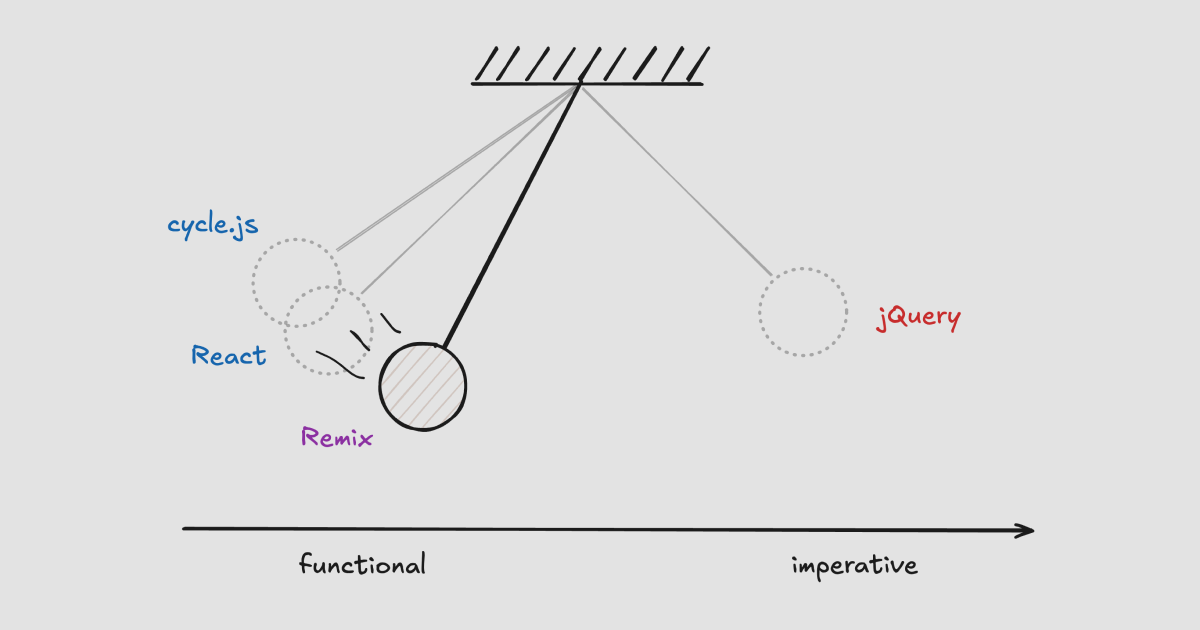
<p>Remix v3 is a signal of stronger <a href="https://cassidoo.co/post/annoyed-at-react/">frustrations</a> in React community and desire for a change. The functional ↔ imperative pendulum is starting to swing the other direction.</p>
<p><img src="/figma/og_remix.png" alt="" /></p>

      ]]></content>
    </entry>
  
    <entry>
      <id>https://frantic.im/music-player</id>
      <title>A Side Project Story: Music Player</title>
      <updated>2025-10-11T12:00:00+00:00</updated>

      <link rel="alternate" href="https://frantic.im/music-player" />
      <summary>One of my most successful side projects had exactly 2 daily active users.</summary>
      <content type="html"><![CDATA[


        <p>One of my most successful side projects had exactly 2 daily active users.</p>
<p>When I was growing up I loved listening to music, especially my parents’ cassette tapes and CDs. Back then music had a physical form. You had to take a magical artifact and carefully put it into a special machine that would produce sounds.</p>
<p>My kids growing up experience none of that. From their perspective, we do something with our phones and music just appears from a speaker. The cause and effect far apart.</p>
<p>I wanted to change that. I wanted to give them agency over what’s playing, and create an association between a physical medium, label, picture and song.</p>
<p>So here are the principles I had in mind:</p>
<ul>
<li>One physical object == one song</li>
<li>Adding new songs should be cheap and easy</li>
</ul>
<p>I did a brief research online and couldn’t find anything that fits the requirements. And I’ll be honest – I was delighted, it meant I can actually craft something novel and useful for my family and not just buy off-the-shelf solution.</p>
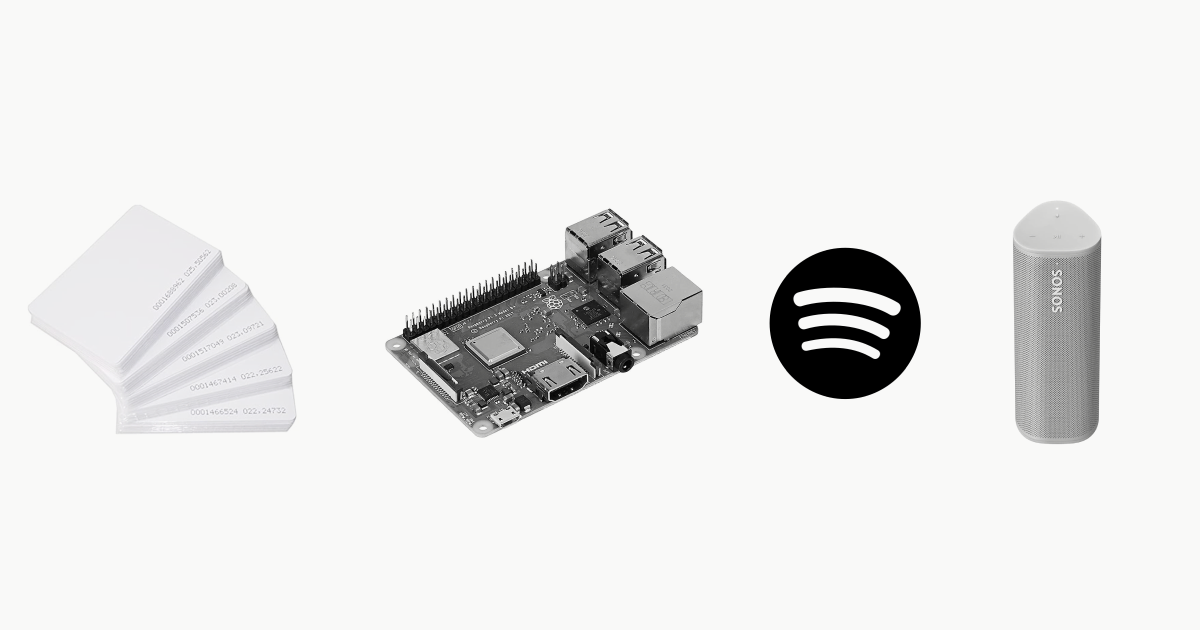
<p>A few days later, I had the “Music Player” (this was way before I started understanding that a good name is important). Each record was an RFID card with an image and title printed on it. You had to take this simple artifact, tap it at a special device and the music would play.</p>
<p><img src="/figma/music_player_components.png" alt="Components of the project: RFID cards, Raspberry Pi, Spotify and Sonos" /></p>
<p>It was powered by an old Raspberry Pi, simple RFID card reader and my existing Sonos speaker. Spotify served as the music library, and adding new songs there was very easy. Here’s how it worked.</p>
<p>The playback part was pretty <a href="https://github.com/frantic/miniplayer/blob/master/scripts/daemon.js">simple</a>: read RFID tag, find a song, send it to play on Sonos (this was the simplest setup because we already had an old Sonos speaker that we used for playing music).</p>
<p>But what made this project successful was how easy it was to add new songs. When we found a song we liked we’d just add it to a playlist on Spotify.</p>
<p>Which brings me to the secret sauce – the admin panel (not an overkill, I promise). It was a React app that used Spotify API to pull a list of songs from a hardcoded playlist ID. It compared the list with the existing database (stored in Firebase) of RFID ID &lt;&gt; song ID mapping, and if the song was missing from the DB, it would pull artwork, name and artist information from the song metadata. Then it rendered the grid of new songs that had a printer-friendly layout that I printed on a sticker paper, cut into individual labels and stuck them to new RFID cards. Then I used a separate RFID card reader plugged into my computer to quickly associate each card with corresponding song.</p>
<p>This process took me about 10 minutes and my kids would help with it too! After a year we had more than 200 RFID-records.</p>
<p>My kids played music on this Music Player every day for years. The youngest user was less than one year old and barely walked, but took no time to learn that tapping with a card plays the song that’s pictured on the card.</p>
<p>Many friends (with families) that visited our house asked for a system like that. I gave them the instructions but nobody ended up building it. I can’t blame them – this project can feel like too much work to fit into a busy parenting life. If you want to try, the source code (with the shopping list of materials) is here <a href="https://github.com/frantic/miniplayer">https://github.com/frantic/miniplayer</a>.</p>
<p>I loved building it, and my 2 favorite customers loved using it.</p>
<p>P.S. As I was polishing this post I saw a <a href="https://fulghum.io/album-cards">similar project by Jordan Fulghum</a>, he used NFC tags &amp; Plex instead of RFIDs &amp; Spotify. Check it out!</p>

      ]]></content>
    </entry>
  
</feed>